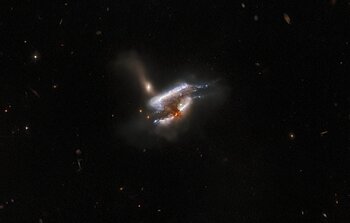
Astronomers have identified a planet-creating disk that resembles an enhanced solar system. Recent visuals from NASA’s Hubble Space Telescope have revealed a gigantic, oddly shaped disk of gas and dust orbiting a lone massive star or a binary star pair approximately 1,000 light-years distant. This disk measures nearly 400 billion miles across, 40 times the diameter of the area surrounding the sun, inclusive of the outer limits of the Kuiper Belt where comets reside.
The telescope captured the system from a side view, enabling scientists to analyze its composition thoroughly. This renders the object, labeled IRAS 23077+6707, as a kind of experimental setting for planet creation, stated Kristina Monsch, the principal author of the new publication in The Astrophysical Journal.
Scientists observed that the creation of new planets can be quite disorderly. “Planet nurseries can be far more lively and tumultuous than we anticipated,” remarked Monsch, an astronomer affiliated with the Harvard-Smithsonian Center for Astrophysics.
What constitutes a protoplanetary disk?
Protoplanetary disks emerge organically during star formation. They supply the fundamental elements that eventually turn into exoplanets, moons, and smaller entities such as asteroids and comets. To grasp how planetary systems evolve, researchers must comprehend the organization of these disks and the manner in which that organization shifts over time.
When disks are observed nearly directly from the side, as in this case, it proves to be particularly informative. This perspective causes the disk itself to obstruct the direct light from the star, similar to covering a bright lamp with your hand. Consequently, the disk appears as a dark stripe in the center, with luminous regions above and below where light reflects off dust particles.
This is why researchers compare IRAS 23077+6707 to a burger (though they prefer likening it to a macaron cookie, presented in a chic pastel tone). The team — one member hailing from Transylvania and another from Uruguay, known for its national dish called chivito — has affectionately named it “Dracula’s Chivito” in homage to their backgrounds.
Hubble’s position enabled scientists to study how matter is arranged around the central star or stars. The volume of dust, the dimensions of the particulates, and how the dust interacts with gas and is stacked vertically all determine the types of planets that might eventually emerge.
What astronomers observed in Dracula’s Chivito was unexpected. Smoky strands rise significantly above the disk instead of settling flat. Long, threadlike filaments extend outward on one side of the disk but not on the opposite side. Its uneven brightness and shape vary according to the light wavelength being examined, indicating that diverse types of dust are positioned at various heights.
The largest developing solar system disk
Theoretically, Dracula’s Chivito could support an expansive planetary system, Monsch indicated. The estimated mass of the disk is 10 to 30 times that of Jupiter — providing ample resources for the formation of several gas giants.
Nevertheless, the images do not clarify whether planets are already in the process of forming, or how many might come to exist. Instead, they reveal something more essential: The environment conducive to planetary growth may remain unbalanced and dynamic for a significantly longer time than previously imagined. As the researchers did not observe jets of material emanating from the system, it is believed that the disk has reached a relatively mature state, no longer acquiring substantial material from its surroundings.
Despite its maturation, Dracula’s Chivito still fundamentally appears as a project in development. Future examinations with additional telescopes may aid astronomers in determining whether this vast, uneven disk will eventually achieve stability, stated Joshua Bennett Lovell, a co-researcher from the Center for Astrophysics.
“We were amazed by the degree of asymmetry in this disk,” Lovell commented in a statement. “Hubble has provided us with a front row view of the tumultuous processes that are shaping disks as they generate new planets — processes that we have yet to fully comprehend but can now investigate in an entirely novel manner.”