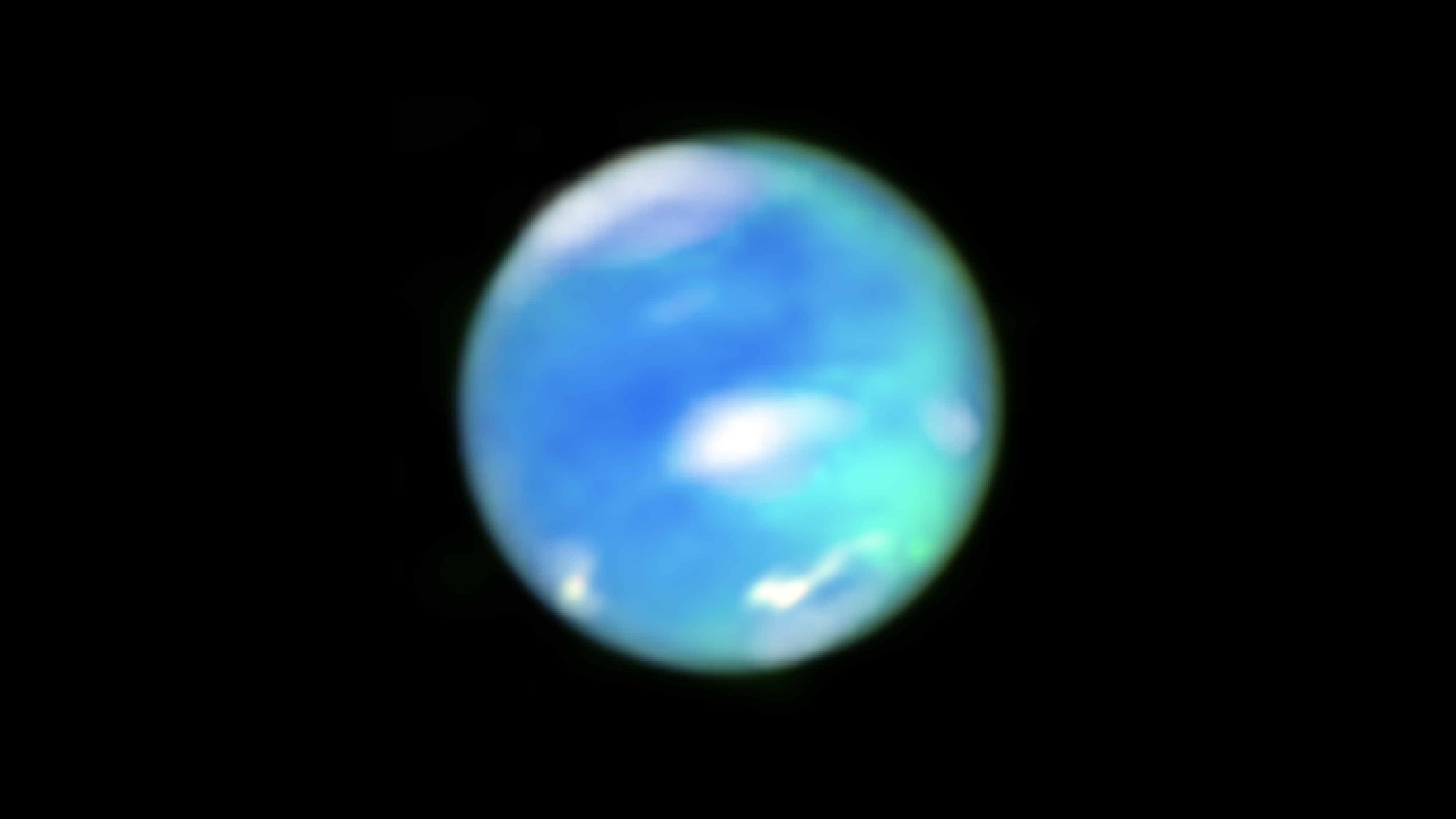
Scientists have described the mapping of Uranus’ upper atmosphere, discovering it to be cooler, thinner, and more unevenly charged than expected. Using the James Webb Space Telescope, a partnership among NASA and its European and Canadian collaborators, researchers observed nearly a complete rotation of Uranus, capturing faint molecular emissions high above the clouds. This investigation resulted in an unprecedented timelapse video of nearly one complete Uranian day.
Infrared observations indicate that Uranus’ ionosphere lacks uniformity. The study, published in the Geophysical Research Letters journal, centers on the development of the ice giant’s auroras and the effect of its atypically tilted magnetic field. “This is the first instance where we’ve been able to visualize Uranus’ upper atmosphere in three dimensions,” stated Paola Tiranti, the lead author from Northumbria University, UK. “Thanks to Webb’s sensitivity, we can follow how energy ascends through the planet’s atmosphere and even observe the impact of its asymmetric magnetic field.”
Although it has the potential to shed light on interactions between distant giant exoplanets and their cosmic environments, Uranus’ charged upper layer remains one of the least comprehended in the solar system. Previously, scientists relied significantly on indirect estimates.
The team monitored a faint infrared emission from a charged molecule known as trihydrogen cation, formed high above the planet where sunlight and cosmic particles interact with the atmosphere. This glow, which fluctuates with temperature and particle density, enables scientists to analyze Uranus’ ionosphere structure. The findings indicated a weaker atmosphere than previously believed, verifying that the upper atmosphere is comparatively cool and appears to be consistently decreasing in temperature, a trend observed over the last 30 years.
Due to Uranus’ sideways rotation, it experiences the most extreme seasons in the solar system, with its poles facing the sun for 21 consecutive years, leaving the other half in darkness for two decades. “Uranus’ magnetosphere is among the most peculiar in the Solar System,” remarked Tiranti, discussing the planet’s magnetic shield. “It’s tilted and displaced from the planet’s rotational axis, which results in its auroras sweeping across the surface in intricate patterns.”
Researchers identified bright and dim auroral bands associated with the planet’s unusual magnetic field. Two bright bands illuminate near the poles, resembling patterns observed on Jupiter. This unusual geometry likely directs energy unevenly into the atmosphere, resulting in areas with varying charged activity.
Before Webb’s 2023 observations, Uranus was mainly viewed as a featureless blue sphere approximately 2 billion miles from Earth. The telescope unveiled the planet’s peculiar vertical rings, numerous moons, storms, and a polar cap. With similar planets prevalent around other stars, researchers aim to leverage the understanding of energy, temperature, and charged particles around Uranus to establish a real-world benchmark for interpreting distant worlds.