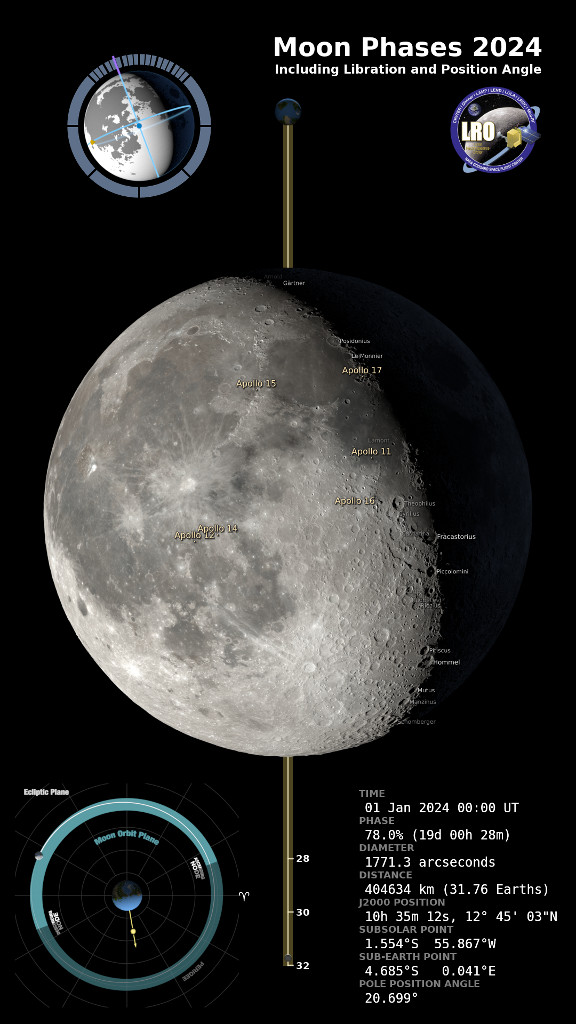
In the United States, the New Moon takes place tonight, December 19, when the Moon is almost imperceptible in the evening sky, marking the conclusion of the waning crescent phase and the commencement of a new lunar cycle. Nevertheless, in various regions worldwide, based on time zones, the New Moon might occur on December 20.
What is the current moon phase?
As of Friday, December 19, the moon phase is New Moon (if you are located in the U.S). This indicates that 0% of the moon is illuminated tonight, according to NASA’s Daily Moon Observation.
When will the next full moon happen?
The next full moon is set for January 3. The previous full moon occurred on December 4.
What do moon phases signify?
As per NASA, the Moon takes approximately 29.5 days to finish one complete cycle. During this period, it goes through a succession of phases as it revolves around Earth. Even though the same hemisphere of the Moon consistently faces us, the extent of sunlight reflecting from its surface fluctuates, thus causing it to appear fully lit, partially illuminated, or entirely unseen at different moments throughout the cycle. This sequence is categorized into eight principal lunar phases:
New Moon – The moon is situated between Earth and the sun, resulting in the side we see being dark (essentially, it’s invisible to the observer).
Waxing Crescent – A small portion of light emerges on the right side (for those in the Northern Hemisphere).
First Quarter – One-half of the moon is illuminated on the right side, resembling a half-moon.
Waxing Gibbous – More than half is lit, yet it’s not completely full.
Full Moon – The entirety of the moon’s face is bright and fully visible.
Waning Gibbous – The moon begins to lose light on the right side. (Northern Hemisphere)
Third Quarter (or Last Quarter) – Another half-moon, but now with the left side illuminated.
Waning Crescent – A narrow sliver of light lingers on the left side before becoming dark once more.