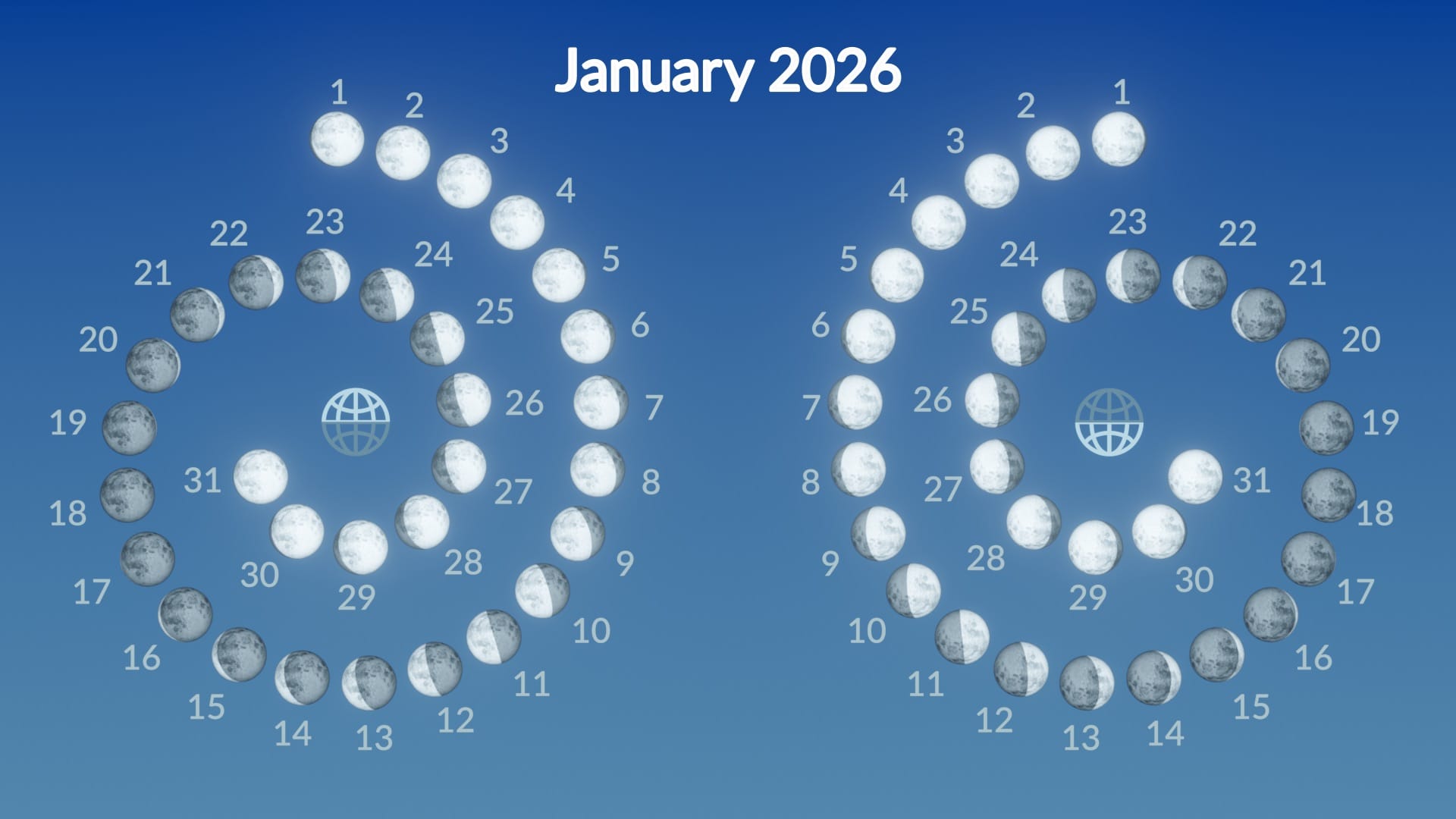
We are nearing the conclusion of the present lunar cycle, with just a few days left for visibility. Nonetheless, a sliver can still be seen tonight, so get your binoculars or telescope and check out what you can discover.
What is the current Moon phase?
As of Wednesday, Jan. 14, the Moon phase is Waning Crescent. Per NASA’s Daily Moon Guide, 17% of the Moon will be lit up tonight.
Even without visual equipment tonight, you should be able to spot the Aristarchus Plateau. This area is found on the far left of the Moon, in the center. For those in the Southern Hemisphere, it will be on the right side of the Moon. If you possess binoculars or a telescope, these will assist you in viewing the Grimaldi Basin.
When will the next Full Moon occur?
The upcoming Full Moon will take place on Feb. 1. The previous full moon was on Jan. 3.
What do Moon phases refer to?
Moon phases are the various stages of the lunar cycle, which NASA indicates takes roughly 29.5 days. This duration is what it takes for the Moon to make a complete orbit. As it revolves around Earth, it goes through eight unique phases. The same side of the Moon consistently faces Earth, but the sunlight that illuminates it varies based on its orbital position. This is why the Moon might look full, partially lit, or entirely dark. The eight phases of the lunar cycle include:
New Moon – The Moon is situated between Earth and the sun, resulting in the side we see being dark (invisible to the eye).
Waxing Crescent – A small strip of light becomes visible on the right side (Northern Hemisphere).
First Quarter – The right side of the Moon is illuminated, mirroring a half-Moon.
Waxing Gibbous – More than half is lit, yet it has not reached full illumination.
Full Moon – The entire surface of the Moon is illuminated and completely visible.
Waning Gibbous – The Moon begins to lose light on the right side (Northern Hemisphere).
Third Quarter (or Last Quarter) – Another half-Moon appears, but this time the left side is illuminated.
Waning Crescent – A thin band of light persists on the left side before it goes dark once more.